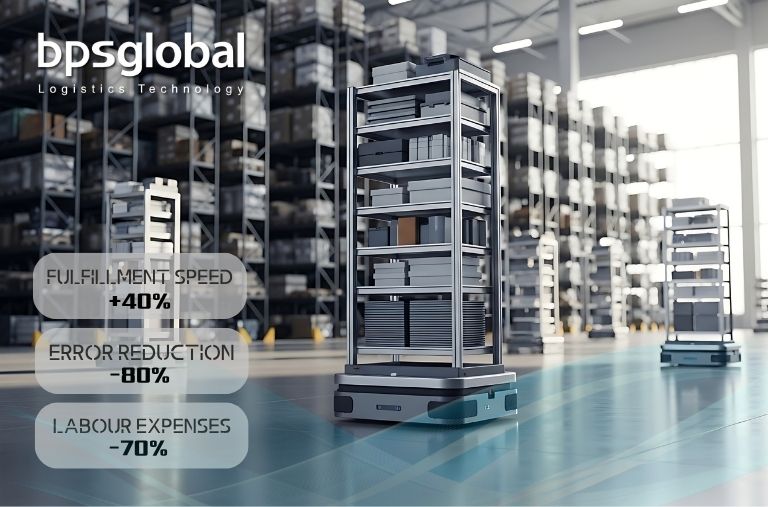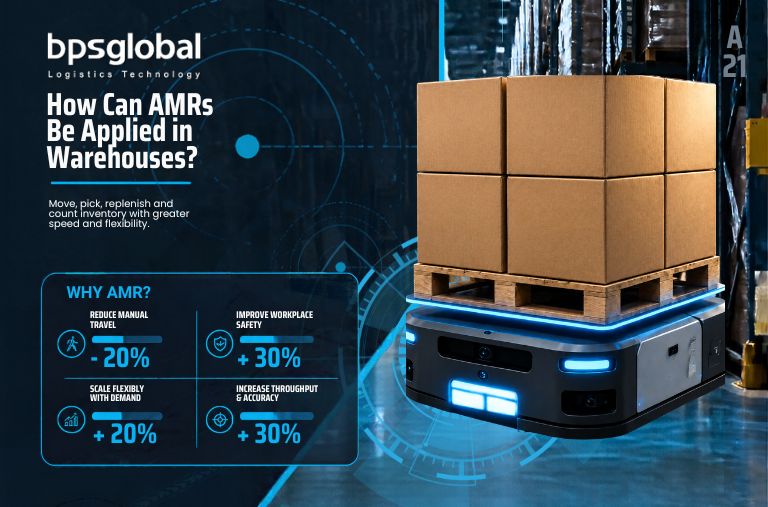
A batch of goods often undergoes multiple transfers from receiving, putaway and picking to outbound shipping. If every stage relies on staff transporting goods back and forth with hand trucks, it not only consumes significant transport time but also slows down picking and shipping operations. Autonomous Mobile Robots (AMRs) can automatically deliver goods to designated locations according to task instructions, helping connect different warehouse operations, reducing repetitive handling and enabling smoother goods flow.
How Do AMRs Work?
Common AMR models combine laser sensors, cameras or other sensing devices to identify their surroundings, position themselves and plan routes. Some models can slow down, stop or reroute according to predefined rules when they detect people or obstacles.
Compared with material-handling equipment that relies on fixed guidance paths, AMRs can autonomously plan routes based on facility maps and sensor data. However, their actual performance still depends on equipment design, navigation configuration and site conditions.
Four Key Warehouse Applications of AMRs
1. Goods transportation: AMRs can transport goods from the receiving area to storage areas, as well as move picked goods to packing or outbound locations, reducing employees’ repetitive cross-zone trips with hand trucks.
2. Goods-to-person picking: In a goods-to-person picking process, AMRs can deliver totes or designated shelving units to picking workstations. Employees can then focus on picking, verification and packing without frequently entering and exiting storage areas. This approach is particularly suitable for operations with a wide range of SKUs, high order volumes and substantial transport needs between picking and storage locations.
3. Automated replenishment: When picking locations require stock replenishment, AMRs can transport backup inventory to designated locations based on tasks assigned by the system or staff. With inventory data and replenishment rules in place, this helps reduce conflicts between replenishment and picking activities.
4. Inter-process material transfer: AMRs can transport materials between workstations such as receiving, inspection, processing, and packing according to task assignments, reducing manual handling and waiting time during handovers. Processes with repetitive transport routes and clear material flows are particularly suitable for automation.
How Much Efficiency Can AMRs Deliver? What Should Be Assessed Before Implementation?
The benefits of AMRs should not be measured solely by travel speed. Businesses should also assess whether they can reduce handling labour hours, improve delivery consistency and allow employees to focus on picking, inspection, exception handling and other value-added tasks.
OMRON Robotics published a case study in 2025 involving its facility in Pleasanton, California. At the time, technicians had to manually transport parts between storage areas, assembly lines and workstations, with inefficient transport affecting assembly and testing operations. OMRON subsequently deployed OL-450S AMRs to automatically transport different types of goods and assign transport tasks through software, without modifying aisles or workstation layouts. The project completed hundreds of transport tasks per month, freed up more than 20 hours of technician time per week, and improved material-handling productivity by 30%*.
*The above reflects results from a specific facility. Improvements at other warehouses will depend on site conditions, handling requirements, and system configuration.
Before purchasing AMRs, businesses should record the number of daily transport tasks, time required for each transfer, and manpower involved. They should also confirm whether aisle widths, turning space, floor evenness, gradients, pedestrian-vehicle interaction, and the weight of racks, totes, and goods meet equipment requirements. In addition, AMRs should be connected to a Warehouse Management System (WMS), Warehouse Execution System (WES), or Warehouse Control System (WCS) to receive transport tasks, report status, and handle exceptions. The systems that need to be integrated will largely depend on the company’s existing infrastructure and workflows.
In general, businesses can begin with a pilot in areas with high transport frequency, repetitive routes, and easily measurable results, then compare efficiency and process performance before and after implementation.
Case Study: Automated Material-Handling Solution for a Hong Kong Government Engineering Department
To address the storage, picking and retrieval needs for spare parts, BPS Logistics Technology (HKLTS) provided an automated material-handling solution for Hong Kong’s Electrical and Mechanical Services Department. The solution combines AI-powered AMRs, smart retrieval cabinets, and a Warehouse Control System (WCS), with the WCS integrated into the client’s IT systems.
When a relevant order is triggered, the system automatically generates storage and retrieval instructions. Users can retrieve the required spare parts from the smart retrieval cabinet simply by entering a password. Through this solution, spare-part storage and retrieval processes operate in a more systematic manner, reducing reliance on manual item-by-item handling while helping save labour costs and storage space.
This project also demonstrates that, for AMRs to deliver their full benefits, they must work in coordination with intelligent storage equipment and information systems rather than operating solely as transport robots.
From AMR Assessment to Warehouse Automation Solutions
AMRs can improve goods transportation, goods-to-person picking and inter-process material transfer. However, achieving genuine improvements in warehouse efficiency also requires alignment with facility layout, operational workflows and information systems.
With more than 20 years of experience in logistics technology, BPS Logistics Technology (HKLTS) provides solution design, consultancy and logistics automation services. We can assess suitable AMR applications based on each company’s operational needs and combine storage equipment with system integration to develop automation solutions tailored to site conditions. From needs analysis and equipment configuration to implementation, we help businesses ensure that automation investments align with business objectives and deliver sustained improvements in operational efficiency.