Which Warehouse Processes Can AMRs Improve? What Conditions Should Be Confirmed Before Implementation?
The main purpose for enterprises to introduce Autonomous Mobile Robots (AMRs) is to reduce the time employees spend moving goods back and forth, while improving the efficiency of processes such as receiving, replenishment, and picking. However, once an AMR is put into operation, will it necessarily deliver the expected benefits? The answer is clearly no. If the aisles are unsuitable for robot navigation, workstations are poorly positioned, or the existing systems cannot support integration, the AMR may operate smoothly yet fail to improve overall efficiency. Therefore, the key to AMR implementation lies not only in selecting the right equipment, but also in identifying processes suitable for automation and confirming that the existing facility and systems are ready.
How AMRs Improve Warehouse Efficiency
AMRs are particularly suitable for high-frequency material handling tasks and warehouse environments where destinations frequently change. During receiving and put-away, AMRs can automatically transport goods to designated locations. In replenishment and picking processes, they can support a “goods-to-person” model by delivering racks or totes to workstations, reducing the need for staff to walk between racks.
For packing and dispatch, AMRs can also handle material transportation between workstations, reducing manual cart pushing and waiting time. For warehouses with high order volumes, these improvements not only reduce repetitive handling but also allow employees to focus on higher-value tasks such as picking, verification, and quality inspection. As a result, warehouse automation extends beyond a single process to cover the entire logistics workflow.
Benefits of AMR Implementation
When evaluating logistics automation, enterprises are usually most concerned with whether manpower can be redeployed to higher-value work, whether orders can be completed faster, and whether operational errors can be reduced. In addition to equipment operating speed, companies should also assess picking accuracy, order processing time, staff walking distance, and throughput during peak periods.
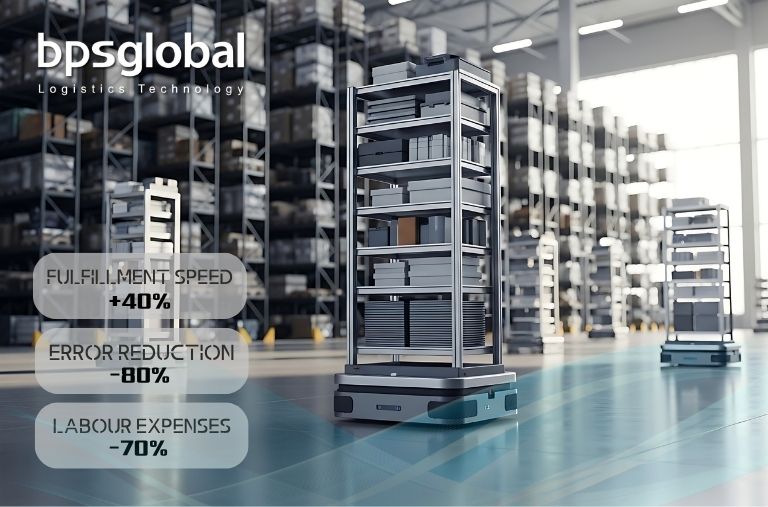
According to relevant data, automation solutions can potentially deliver the following benefits:
- 40% improvement in fulfilment speed: Faster order processing and dispatch
- 80% reduction in errors: Lower error rates, reducing replenishment and order-correction costs
- 70% reduction in labour costs: Less repetitive handling and manual work
*The above are indicative figures from relevant sources. Actual results will vary depending on warehouse layout, order profile, existing workflows, and the level of system integration. They should not be regarded as guaranteed outcomes for every AMR project.
Integrating AMRs with a warehouse management system enables them to automatically receive and execute transport tasks, reducing manual task assignment and repetitive operations. Enterprises should use pre-implementation operational data as a baseline to objectively assess return on investment.
Four Conditions to Confirm Before AMR Implementation
- Identify efficiency bottlenecks and address the root cause: Understand employees’ daily handling time, busy routes, and processing volumes across each process to determine whether the issue lies in put-away, replenishment, picking, or dispatch.
- Assess the warehouse environment: Aisle width, floor evenness, thresholds, turning points, and intersections between staff and forklifts all affect AMR operation. Adequate parking and charging areas should also be reserved.
- Confirm system compatibility: AMRs need to receive transport tasks and destination information. Integration with systems such as WMS and WCS can reduce manual task assignment and make workflows smoother.
- Calculate return on investment: Beyond equipment costs, companies should consider system integration, facility modifications, maintenance, and training costs. A pilot implementation in a suitable area is recommended before expanding deployment based on actual data.
Case Study: Hong Kong E-commerce Warehouse Automation Achieves 3x Order Processing Efficiency
BPS Logistics Technology designed an integrated automation solution for an approximately 40,000 sq ft e-commerce warehouse in Kwai Chung, Hong Kong. During peak periods, the client needed to process more than 10,000 orders per day. The original picking method was prone to errors, and staff had to work long hours to cope with continuously increasing order volumes.
The BPS team combined mezzanine racking, an AMR-based “goods-to-person” picking model, and automated conveyor systems to redesign the storage, picking, packing, and dispatch processes. This reduced staff movement between racks and improved the connection between different operations.
The overall results after project completion included:
- Picking accuracy of 99.9%
- Order processing efficiency increased to three times the original level
- A 40% reduction in manpower requirements
*The above figures are based on the complete warehouse automation solution.
This case demonstrates that effective warehouse automation requires the coordinated planning of equipment, storage layout, and operational processes to translate automation capabilities into tangible operational benefits.
More AMRs Do Not Necessarily Mean Better Results — Overall Planning Is Key
AMRs can improve multiple processes, including receiving, put-away, replenishment, picking, and dispatch. However, the ultimate benefits still depend on whether facility conditions, system integration, and process design are properly aligned.
BPS Global has long focused on logistics automation and warehouse system integration, with extensive experience spanning process analysis, solution design, equipment selection, system integration, and project implementation. Our team assesses the most suitable AMR applications based on each enterprise’s order volume, operating model, facility constraints, and investment objectives — helping businesses reduce repetitive handling, improve order processing efficiency, and build more flexible, stable, and scalable warehouse automation solutions.