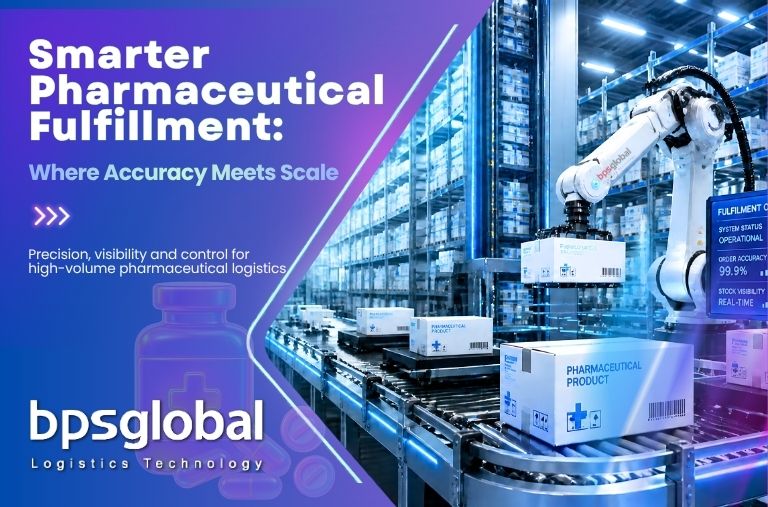
In pharmaceutical logistics, a delayed order is inconvenient. An inaccurate one can be far more serious. That is why pharmaceutical distributors, pharmacy chains, and healthcare e-commerce businesses need fulfilment operations built around precision, visibility, and control — not speed alone.
BPS Logistics Technology helps these businesses modernise their warehouses with intelligent automation that supports high-volume fulfilment while protecting the standards the industry demands.
The Real Pressure on Pharma Warehouses
Pharmaceutical fulfilment is rarely straightforward. A single operation may handle prescription medicines, wellness products, medical devices, personal-care items, and temperature-sensitive stock — all with different handling rules and customer expectations.
Meanwhile, the way patients and consumers purchase healthcare products is changing. More orders now originate online, with expectations for rapid dispatch, accurate delivery updates, and convenient collection options. Traditional manual warehouses can meet these needs at low volume, but they become harder to manage as order volumes, SKU counts, and channel complexity increase.
The challenge is not simply to move more goods. It is to move the right goods, in the right condition, with complete operational confidence.
Automation That Supports Compliance and Control
For pharmaceutical businesses, automation must do more than increase throughput. It should strengthen the controls that keep operations safe and accountable.
BPS Logistics Technology focuses on connecting robotics with intelligent workflow management, so that every task — from replenishment to picking and dispatch — can be coordinated consistently across the warehouse.
This enables operations to better manage:
• Product traceability throughout the fulfilment journey
• Stock rotation and expiry-related handling requirements
• Batch-level visibility across inventory and order workflows
• Controlled picking processes that reduce the risk of human error
• Clear operational data for planning, auditing, and continuous improvement
By bringing goods to operators rather than requiring staff to search for them, goods-to-person automation also creates a more structured and repeatable picking environment.
Designed Around Pharmaceutical Order Profiles
No two pharmaceutical warehouses operate in exactly the same way. Some prioritise rapid single-item e-commerce fulfilment; others focus on replenishing pharmacy branches, managing bulky stock, or supporting urgent orders alongside routine demand.
BPS Logistics Technology takes an operation-first approach. We assess how products flow through the facility, where bottlenecks occur, and which order types drive the greatest operational pressure. The resulting solution is designed around those realities.
Typical applications include:
• E-commerce fulfilment for direct-to-consumer healthcare orders
• Pharmacy replenishment across retail and clinic networks
• High-density storage for growing SKU ranges
• Multi-channel fulfilment combining online, retail, and wholesale demand
• Returns handling to recover value and maintain inventory accuracy
Growth Without Disruption
One of the biggest concerns for pharmaceutical businesses considering automation is scalability. A solution that works today may not support tomorrow’s volumes, new product categories, or additional fulfilment channels.
Modular robotics offers a practical answer. Businesses can automate a defined area first — such as e-commerce picking or high-density storage — then expand robot fleets, workstations, and storage capacity as demand evolves.
This phased approach reduces upfront risk and allows automation investment to keep pace with business growth.
From Efficiency to Competitive Advantage
Automation should not be viewed simply as a cost-saving exercise. For pharmaceutical businesses, it can become a foundation for better customer service, stronger inventory control, and greater resilience during demand peaks.
With BPS Logistics Technology, pharmaceutical operators can build fulfilment operations that are accurate by design, adaptable by nature, and ready to scale with the future of healthcare commerce.