From “People to Goods” to “Goods to People”: How Goods-to-Person Systems Are Reshaping Asian Fulfilment

Across Asia, warehouse operators are facing a familiar combination of pressures: rising labour costs, limited industrial space, more SKUs, tighter delivery windows and increasingly volatile order volumes. Goods-to-Person (GTP) automation offers a practical response by reversing the traditional fulfilment model - instead of sending staff to search for products across the warehouse, automated systems bring the right goods directly to a fixed picking workstation.
For B2B enterprises, this is not simply a technology upgrade. It is a way to make fulfilment more predictable, scalable and controllable - particularly in dense markets such as Hong Kong, Singapore and major Chinese manufacturing and e-commerce hubs.
What Is Goods-to-Person?
In a conventional Person-to-Goods (PTG) warehouse, pickers walk between storage locations, locate items, pick them, and return to a packing or consolidation area. As order volumes and SKU counts grow, walking time, congestion, replenishment delays and picking errors tend to increase.
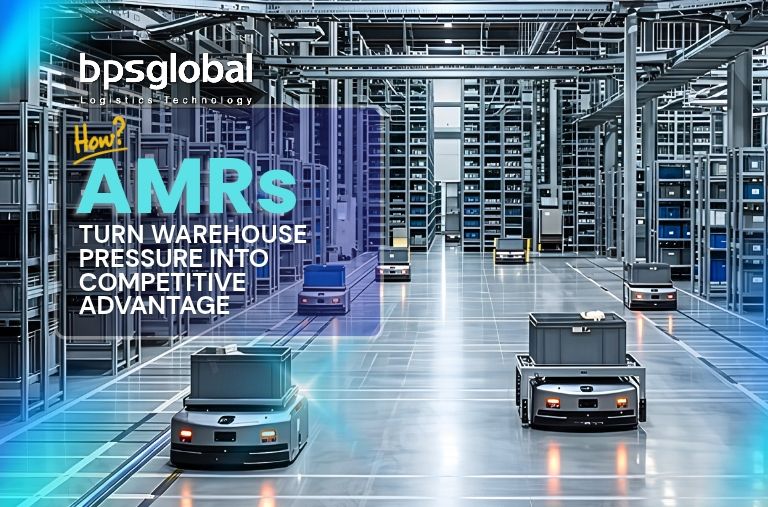
In a Goods-to-Person (GTP) model, automated equipment such as Autonomous Mobile Robots (AMRs), automated storage and retrieval systems (AS/RS), pallet shuttles, or high-bay robots retrieves the required tote, carton, shelf or pallet and delivers it to an operator at a workstation. The employee remains in a defined zone to pick, verify, pack or consolidate orders.
GTP does not eliminate people from the warehouse. Rather, it redeploys staff from repetitive travel and searching to higher-value work such as quality control, exception handling, packing, maintenance and process improvement.
Why It Matters in Asia
Asian fulfilment operations often face constraints that make GTP particularly compelling. Land and rental costs are high, warehouse footprints are constrained, labour availability can be inconsistent, and customer expectations for faster, more accurate delivery continue to rise.
At the same time, B2B supply chains are becoming more complex. Manufacturers, distributors, healthcare providers, electronics companies and retail suppliers must manage more SKUs, smaller and more frequent replenishment orders, stricter traceability requirements and seasonal demand spikes.
GTP systems address these pressures in 5 several ways
- Higher Throughput: Automated retrieval and delivery reduce non-productive walking time, allowing operators to focus on picking and verification.
- Better Space Economics: Dense storage layouts and vertical automation can increase capacity within an existing facility, helping businesses defer relocation or expansion.
- Improved Accuracy and Traceability: System-directed picking, integrated WMS (Warehouse Management System) / WES (Warehouse Execution System ) workflows, and barcode or RFID verification reduce manual errors and improve inventory visibility.
- Greater Resilience: Automated systems can help maintain stable output during labour shortages, peak seasons and sudden demand surges.
- Safer Operations: Less walking, lifting, and repetitive handling can reduce fatigue and workplace-safety risks.
A Practical Example
An Indonesian bearing distributor implemented an automated storage system with a mini-load buffer and GTP picking stations to support rising order volumes and a broader SKU range.The solution reduced manual searching and walking, improved ergonomics, streamlined replenishment and consolidation, and supported higher service levels as the business grew.
This illustrates an important point: GTP is not only relevant to high-volume e-commerce. It can also create measurable value in industrial distribution, spare parts, pharmaceuticals cold chain, retail replenishment, and manufacturing supply chains - environments where accuracy, traceability and space efficiency matteras much as speed.
Choosing the Right GTP Model
There is no universal GTP configuration. The right solution depends on product characteristics, order profile, throughput targets, building constraints, and existing IT systems.
Common approaches include:
1. AMR-based GTP: Mobile robots transport shelves, totes or carts to fixed picking stations; well suited to flexible operations with changing layouts and mixed SKU profiles.
2. AS/RS and shuttle-based GTP: Automated storage systems retrieve totes or cartons and deliver them to picking stations; often appropriate for high-density, high-throughput operations.
3. Very Narrow Aisle automation: Uses vertical space and narrow travel paths to increase storage capacity, especially valuable in land-constrained Asian markets.
4. Hybrid fulfilment: Combines GTP picking with conveyors, sortation, pick-to-light, robotic arms, and manual handling where flexibility is required.
For many B2B operators, the most effective first step is not a full warehouse rebuild. It is identifying the highest-friction process - often picking, replenishment, or spare-partsretrieval - and deploying a modular solution that can expand as volumes grow.
The Business Case
A successful GTP project should be evaluated against operational outcomes, not robot counts. Key metrics include orders or order lines processed per hour, picking accuracy, storage density, labour hours per order, order-cycle time, inventory visibility and cost per fulfilment transaction.
BPS Logistics Technology previously supported a local health-supplement e-commerce business in Kwai Chung that moved from a traditional PTG model to a compact AMR-based GTP system. The reported results included a reduction in picking staff from five to two, throughput increasing from 450 to 1,200 order lines per hour, picking accuracy improving to 99.97%, and storage capacity increasing by 60% within the same footprint.
In another Hong Kong project, BPS Logistics Technolgy combined mezzanine racking, AMR-based GTP picking, and automated conveyors to redesign storage, picking, packing and dispatch. The reported outcomes included 99.9% picking accuracy, a threefold increase in order-processing efficiency, and a 40% reduction in frontline manpower requirements.
These examples do not suggest that every warehouse will achieve identical results. They do show why GTP should be assessed as a business transformation programme: with the right workflow design, system integration, and implementation approach, automationcan deliver both operational and financial returns.
How BPS Logistics Technology Can Help
BPS Logistics helps B2B enterprises turn GTP from a concept into a practical, scalable warehouse strategy. We provide end-to-end logistics automation solutions - from initial assessment and solution design through implementation, systems integration and ongoing project management.
Our approach includes:
- Operational Assessment: Analyse product profiles, order patterns, SKU complexity, storage constraints, labour requirements, and existing systems to identify where GTP will generate the strongest return.
- Solution Design: Recommend the appropriate combination of AMRs, Automated Guided Forklift (AGFs), high-bay robots, storage systems, conveyors, sortation, and pick-to-light technologies.
- Systems Integration: Connect automation with WMS, Enterprise Resource Planning (ERP), WES, and other enterprise systems to create a coordinated workflow from order receipt to dispatch.
- Phased Implementation: Deploy modular solutions that can begin with a defined bottleneck and scale as business needs evolve — reducing disruption and protecting capital investment.
- Ongoing Optimisation: Support performance monitoring, maintenance, workflow refinement and future expansion.
For businesses operating in Asia and Hong Kong, BPS Logistics can help design a GTP fulfilment model that makes better use of limited space, reduces dependence on repetitive labour, improves accuracy and builds a more resilient supply chain. Contact us to arrange awarehouse assessment.