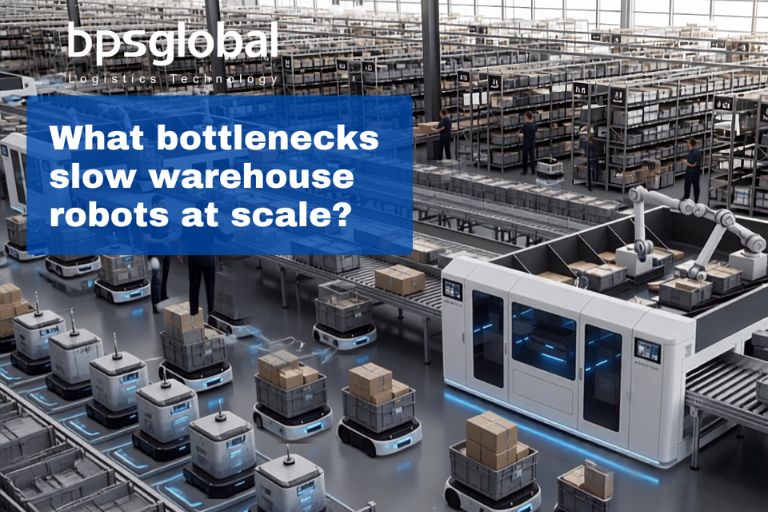
When aiming to boost order fulfillment efficiency, a company's reflexive response is often to buy more warehouse robots. However, blindly expanding hardware can lead to imbalanced task distribution and queuing bottlenecks at workstations, yielding little to no increase in overall output. The key lies not in equipment volume, but in whether the warehouse can evolve into a complex logistics system capable of precise dispatching and multi-fleet coordination as the robot population grows.
Three Operational Bottlenecks in Fleet Expansion
- Path Congestion & Constant Yielding: A massive influx of robots rushing toward high-demand rack zones or the same picking station causes frequent yield stops in narrow aisles, wasting valuable operational time.
- Resource Mismatch & Idle Waiting: Upstream traffic jams leave robots idling on the floor, while robots elsewhere sit idle due to task gaps, preventing hardware assets from delivering full value.
- Downstream Workstation Bottlenecks: Front-end transport operates at full capacity, but back-end picking and packaging cannot keep pace, causing long robot queues outside workstations and stalling total throughput.
Smart Dispatching: The Core Brain Driving Automation Success
Solving multi-robot coordination challenges requires moving beyond simple "nearest-neighbor" dispatch rules. It demands a smart dispatching system with a global perspective that evaluates real-time fleet positions, optimal routes, live traffic, task priorities, and workstation load in real time.
- Traditional Logic: Assigns a task to Robot A, located 20 meters away, even if its mandatory path is gridlocked.
- Smart Dispatching: Reassigns the task to Robot B, 50 meters away on a clear path, achieving a faster overall completion time.
Case Study: BPS Logistics Technology's Integrated System Solution
When upgrading warehouse operations for a Hong Kong power company, BPS Logistics Technology avoided simply stacking up hardware. Instead, they eliminated operational bottlenecks through deep software and hardware integration:
Overcoming Coordination Bottlenecks to Unleash Automation Potential
Purchasing additional robots is only the first step in logistics modernisation. To truly resolve multi-robot coordination bottlenecks, enterprises need a dispatching architecture that tightly aligns with real-world business workflows. Leveraging deep expertise in logistics automation and system integration, BPS Logistics Technology takes a holistic approach to help businesses build highly stable, efficient, and scalable end-to-end automation solutions.