Goods-to-Person vs Person-to-Goods: The Key Choice for Boosting Warehouse Efficiency
Are your warehouse staff constantly walking back and forth every day, spending excessive time locating and picking items — yet still struggling to keep up with growing order volumes? The root issue often isn't manpower, but whether your picking model suits your business.
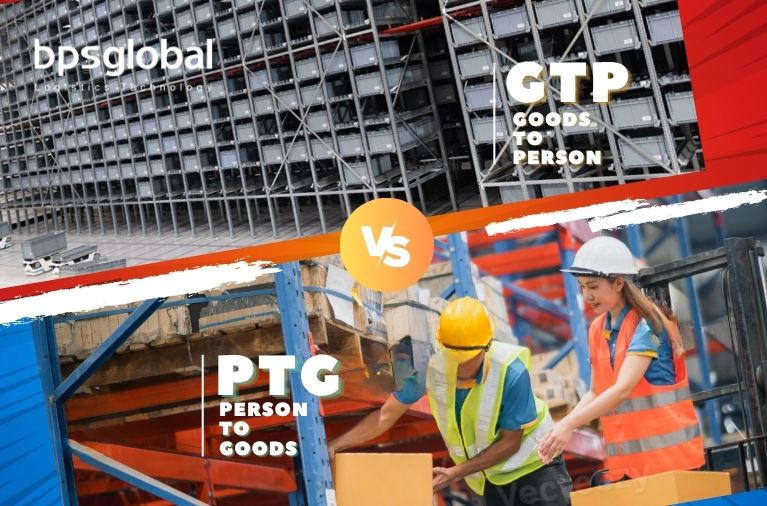
"Goods-to-Person" (GTP) refers to automated systems delivering items directly to a stationary picking workstation, while "Person-to-Goods" (PTG) requires workers to travel to storage locations to pick items. Let's break down these two approaches to help you determine which model can maximise your operational performance.
Person-to-Goods vs Goods-to-Person: A Comprehensive Comparison
With high rents and ongoing labour shortages in Hong Kong, choosing the right picking model has a major impact on operating costs.
A Goods-to-Person system replaces manual picking with automation, significantly improving efficiency while maximising limited warehouse space — making it especially suitable for growing businesses.
While Person-to-Goods has a lower entry barrier, increasing order volumes will gradually drive up labour and space costs, eroding profit margins.
Key Differences
Technology Behind Goods-to-Person Systems
It's important to note that GTP is not a single piece of equipment, but a combination of automation solutions. Depending on warehouse size, SKU count, and order profiles, businesses can choose the most suitable setup:
- Grid-based Systems
Robots transport entire shelves or pallets to picking stations. These systems require less rigid rack structures, are faster to deploy, and allow multiple related SKUs on the same shelf — improving picking efficiency. - Shuttle Systems
Extract individual totes and deliver them to workstations before returning them. With standardised structures, they support extremely high speed and throughput — ideal for high-frequency operations with relatively concentrated SKUs. - Robotic GTP with Fixed Racks
Robots retrieve totes from pre-designed fixed racking systems. These solutions maximise vertical space (up to 30 feet or more), making them ideal for high-SKU, high-density storage environments. - Carousel Systems
Use horizontal or vertical rotation to bring items to operators. They are ideal for space-constrained warehouses and help improve picking accuracy while reducing manual errors.
Each architecture has its strengths in space utilisation, speed, and investment cost. Businesses should choose based on their order structure, SKU characteristics and future scalability — not just the level of automation.
How to Choose the Right Model for Your Warehouse
Selecting the right picking model requires evaluating several factors:
- Daily Order Volume
If you process a few hundred orders per day with limited growth, PTG may suffice. But if orders exceed 1,000 daily or are rapidly growing, GTP offers significant efficiency advantages. - SKU Count and Product Characteristics
The more SKUs and the smaller the items, the greater the benefit of GTP. Large or heavy items may require specialised automation solutions. - Warehouse Size and Lease Terms
With typical lease cycles of 2–3 years, companies must assess ROI timelines. If space is limited but storage needs are growing, GTP's dense storage is ideal. - Seasonal Demand Fluctuations
For businesses with peak seasons, GTP systems provide far greater scalability than relying on temporary labour.
Ultimately, beyond order volume and space, companies should also evaluate ROI, system integration costs, and operational disruption during implementation.
Real Case: How a Hong Kong E-commerce Brand Improved Efficiency
A local health supplement e-commerce brand previously operated a 2,000 sq ft warehouse in Kwai Chung using a traditional PTG model.
As order volume grew to 800 orders per day, five pickers were no longer sufficient. During peak seasons, error rates reached 3%, leading to frequent returns and customer complaints.
After engaging BPS Global for a warehouse assessment, the team recommended implementing a compact AMR-based GTP system and redesigning the warehouse layout.
Results after transformation:
- Picking staff reduced from 5 to 2
- Throughput increased from 450 to 1,200 order lines per hour
- Picking accuracy improved to 99.97%
- Storage capacity increased by 60% within the same space
Most importantly, the company postponed relocating to a larger warehouse, saving significant rental costs.
Tailor-Made Warehouse Solutions by BPS Global
Modern GTP solutions can integrate seamlessly with warehouse management systems (WMS), conveyors, pick-to-light systems, and robotic arms — creating a fully connected workflow from picking to sorting and dispatch.
No matter what stage your business is in, your picking strategy directly impacts operational costs and customer experience.
With extensive experience in Hong Kong and cross-border logistics, BPS Global provides end-to-end warehouse solutions — from PTG setups to full GTP transformation. From system design and equipment selection to process reengineering and daily operations support, BPS delivers one-stop solutions to help your warehouse achieve efficiency, accuracy, and scalable growth.
Contact Us today to start your Goods-to-Person upgrade journey.