所有文章

AMR in APAC: The Strategic Backbone of Scalable Logistics and Manufacturing

发布时间
2026-03-20
AMR in APAC: The Strategic Backbone of Scalable Logistics and Manufacturing

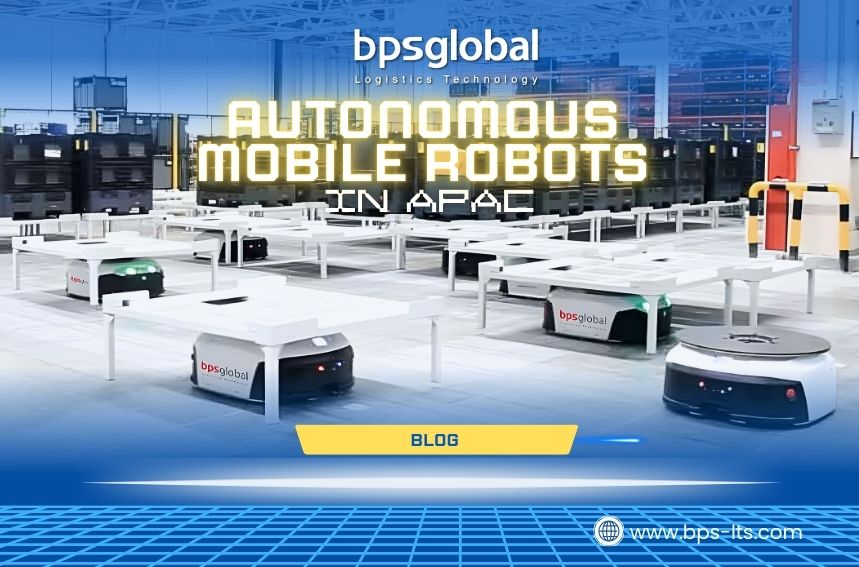
The Asia-Pacific (APAC) logistics landscape is undergoing a fundamental shift. For enterprises in Hong Kong and across the Greater Bay Area, the pressure to scale efficiently while maintaining resilience has moved Autonomous Mobile Robot (AMR) from a "future tech" concept to a core operational necessity.

As a leader in logistics technology and Warehouse Management System (WMS) integration, BPS Logistics Technology recognises that the next five years will be defined by the transition from robotic experimentation to enterprise-wide optimisation.

Market Momentum in APAC

The APAC region continues to lead global AMR deployment, driven by a combination of industrial scale, policy support and competitive intensity. Several structural drivers are accelerating this adoption:

  • E-commerce Volatility: Sustained growth in order volumes requires faster fulfillment cycles
  • Labor Constraints: Rising costs and aging workforces in developed hubs like Hong Kong, Japan and South Korea
  • Infrastructure Modernisation: Significant investment in "automation-ready" facilities, particularly in Southeast Asia
  • Government Backed Transformation: Automation and digitalisation backed by government

From Fixed Automation to Dynamic Operations

Traditional automation (conveyors and fixed sorting) is often too rigid for the modern supply chain. AMRs represent a move toward software-defined logistics.

Comparison: Traditional vs. AMR-Driven Logistics

Feature

Traditional Fixed Automation

AMR-Driven Dynamic Operations

Optimisation

Static layouts

Continuous layout & workflow optimisation

Flexibility

High reconfiguration costs

Infrastructure-light; software-adjusted

Scalability

Fixed capacity

Scalable to match fluctuating deman


For B2B leaders, this flexibility ensures that a facility is not "locked" into a process that may be obsolete in 24 months.

Feature Traditional Fixed Automation AMR-Driven Dynamic Operations
Optimisation Static layouts Continuous layout & workflow optimisation
Flexibility High reconfiguration costs Infrastructure-light; software-adjusted
Scalability Fixed capacity Scalable to match fluctuating demand

For B2B leaders, this flexibility ensures that a facility is not "locked" into a process that may be obsolete in 24 months.

Logistics and Warehousing: Scaling What Already Works

Logistics remains the most established and high-impact domain for AMR in APAC.

As fulfillment networks expand and service-level expectations tighten, AMRs are being deployed at scale to handle internal transport, picking and sorting processes.

Key operational advantages include:

  • Higher throughput and improved order accuracy
  • Mitigation of labor dependency for low-value, repetitive tasks
  • Continuous, around-the-clock operations
  • Enhanced utilisation of vertical and horizontal warehouse real estate

AMR-powered "Goods-to-Person" systems have moved from the fringe to become the core operational standard for major distribution centres. For Third-Party Logistics (3PL) providers and large-scale retailers, the strategic dialogue has matured from small-scale pilots to the sophisticated orchestration of large robot fleets integrated with broader supply chain systems and Warehouse Management Systems (WMS).

Manufacturing: Enabling Flexible Production Environments

Within the manufacturing sector, AMRs are becoming foundational components of broader Smart Factory initiatives. By replacing fixed conveyors with autonomous material flows, manufacturers can achieve a level of responsiveness previously unattainable.

Current high-impact applications include:

  • Autonomous transport of components and finished goods
  • Real-time routing based on production schedules
  • Support for mixed-model and high-variation manufacturing

This flexibility is vital for APAC manufacturers who must balance high-volume efficiency with the rising demand for product customisation. While Japan and South Korea utilise AMR to mitigate demographic labor shifts, China is embedding them into massive digital manufacturing frameworks. This transition allows production systems to adapt rapidly without the need for expensive capital reinvestment or lengthy downtime.

Labor Dynamics: Augmentation at Scale

Labour challenges across APAC are structural, not cyclical. Organisations are navigating the dual pressures of aging populations in developed economies and rising wage floors in traditional manufacturing hubs. Furthermore, the ongoing difficulty in recruiting personnel for labor-intensive roles remains a primary bottleneck.

AMRs are addressing these challenges by automating routine, low-value tasks and enabling a more efficient allocation of human resources. Key impacts include:

  • Increased productivity per employee
  • Improved workplace safety
  • Transition of workers into higher-value, supervisory roles

For B2B organisations, this is less about replacement and more about augmentation at scale. AMRs enable leaner, more resilient operations while supporting workforce transformation.

Technology Maturity and Ecosystem Integration

The current maturity of AMR technology is defined by its deep integration into the broader enterprise digital ecosystem.

Key technological pillars include:

  • AI and Machine Learning: Utilising operational datasets to refine routing logic and fleet coordination
  • Advanced Navigation: Leveraging Lidar and sensor fusion for high-reliability performance in dense environments
  • 5G and Edge Computing: Supporting ultra-low latency and real-time decision-making
  • WMS and ERP Integration: Connecting AMR to Warehouse Management and Enterprise Resource Planning platforms for end-to-end visibility

This level of connectivity transforms AMR from isolated tools into a unified, intelligent operational backbone.

Southeast Asia: Scaling from a Clean Slate

Southeast Asia represents a high-growth opportunity, not because AMRs are new, but because infrastructure is being built with automation in mind. For B2B companies expanding into the region, this creates an opportunity to deploy AMR as a foundational capability rather than a retrofit. Markets such as Singapore, Malaysia, Vietnam and Thailand are investing in:

  • Modern logistics hubs
  • Smart manufacturing facilities
  • Digital supply chain infrastructure

Unlike legacy-heavy environments, many of these facilities are designed to accommodate AMR from the outset. This reduces integration complexity and accelerates time-to-value.

Implementation Considerations

Despite the technological maturity of the sector, achieving a successful AMR deployment requires meticulous strategic planning.

  • Commercial Models: The rise of Robotics-as-a-Service (RaaS) is democratising access by aligning costs with actual operational usage
  • System Interoperability: Ensuring seamless data exchange with existing software stacks is vital for ROI
  • Operational Readiness: Aligning physical facility layouts and workforce skill sets with new robotic workflows
  • Safety and Compliance: Navigating the diverse regulatory landscapes of APAC requires a localised approach to safety standards

These challenges are increasingly mitigated by the availability of standardised platforms and the expertise of seasoned implementation partners.

The Next Five Years: Focus on Scale and Optimisation

Looking ahead, the evolution of AMR in APAC will be defined less by technological breakthroughs and more by execution at scale.

Key trends include:

  • The move toward Enterprise-Wide Deployment across global facility networks
  • Sophisticated Fleet Orchestration involving hundreds of interconnected units
  • Expansion into adjacent markets, including healthcare and specialised retail logistics
  • Integral roles in AI-driven digital strategies and IoT analytics
  • Continuous reductions in Total Cost of Ownership (TCO) through software advancements

Conclusion: From Proven Technology to Strategic Infrastructure

Autonomous Mobile Robots have reached a level of maturity that positions them as a core element of modern operations in APAC.

For B2B leaders, the strategic priority is no longer validation, but execution. Organisations that prioritise scaling deployments, optimising performance, and integrating AMRs into their broader digital ecosystems will unlock significant competitive advantages.

In a region defined by speed, scale and complexity, AMRs provide a reliable foundation for building more responsive and efficient operations.

Contact BPS Logistics Technology (HKLTS) to explore how our specialised WMS and logistics technology projects can future-proof your operations.

联络我们

联系我们的物流自动化专家

Thank you! Your submission has been received!
Oops! Something went wrong while submitting the form.
欢迎

您好!如对我们的服务有任何疑问,欢迎随时与我们联系。

WhatsApp联系
Email Icon
电邮
enquiry@bps-group.net
电话号码
(852) 2763 6874
办公地址
香港九龙观塘海滨道163号 8楼
我们的社交媒体